Event Date
2011-09-12
Event Time
02:30 pm ~ 03:20 pm
Event Location
Wachman 617
Welcome to the Society of Undergraduate Mathematics (SUM) Home Page! The SUM, also known as the Temple University Math Club, features presentations on interesting topics in mathematics as well as job-related talks by visiting scientists. Although the talks are primarily geared toward mathematics majors, all students are invited to attend.
SUM is announcing a new lecture series:
Research Experience for Undergraduates (REU)
In Summer 2002 Mathematics Department ran an NSF sponsored REU program.
The new lecture series will discuss research performed by the REU teams.
The lectures will take place Thursdays at 4pm in Room 617 of Wachman Hall.
Coffee and doughnuts will be served at 3:45 in Faculty Lounge.
Fall 2002
October 17, 4:00
Professor Yury Grabovsky
October 24, 4:00
Professor Yury Grabovsky
October 31, 4:00
Professor Yury Grabovsky
November 7, 4:00
Professor Edward Letzter
"Noncommutative polynomial equations and noncommutative geometries"
November 14, 4:00
Professor Edward Letzter
November 21, 4:00
Professor Edward Letzter
" Irreducible solutions (Continued) "
December 9, 2:40
Anna Godfrey and Alpha Jalloh
" Why are all living cells roughly of the same size?"
"Why do you pay less for a larger box in a supermarket? "
Spring 2003
February 18, 2:00
Professor Juan Gil
"Calculus everywhere: The Catenary"
February 25, 2:00
Temple freshmen Brian Puzar and Justin Somers
"Can all calculus books be wrong? The log vs. exp affair."
March 3, 4:00
Professor Daniel B. Szyld
" Mathematics behind Google"
April 8, 4:30
Professor Longin Jan Latecki
" Video Mining"
The new lecture series will consist of lectures surveying the entire edifice of mathematics.
It will try to show the explosive growth our science has experience during the past century
and at the same time will demonstrate how all of the modern mathematics has its roots in the
classical theories that are learned in the undergraduate level courses.
The lectures will usually take place in the Student Lounge on the 6th floor
of Wachman Hall.
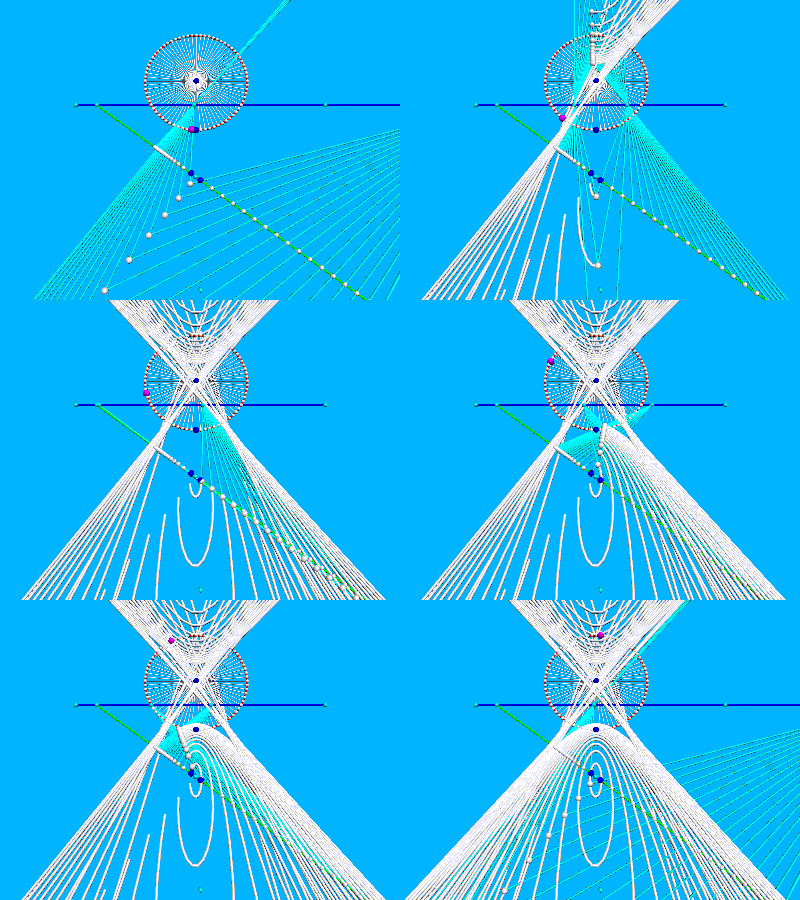
Twenty years ago the study of projective geometry would have seemed somewhat like the study of Latin: good for the brain and a means to keep in contact with the ancients. Today, however, projective geometry is a popular subject with mathematicians and computer scientists. This is due to the new applications to computer vision and to the fact that geometry and geometric thinking are again on the upswing. Moreover, computer science has returned the favor by providing powerful tools for the visualization and diffusion of mathematics. Java applets, animated GIF images, and linked HTML pages allow us to present mathematics and, most particularly, geometry in a way that was unthinkable twenty years ago.
In this talk we will give a short introduction to projective geometry using PyGeo, a powerful and freely available visualization tool written in Python and developed by Arthur Siegel (who may come and participate in the talk.)
Abstract: Many people believe that mathematics consists of two disjoint halves: the continuous part such as stuff we learned from a calculus class and the discrete part such as counting learned from our childhood. This talk discusses the connection between these two. In particular, we will talk about the Mobius inversion in number theory, its history and how to use it to recover the foundamental theorem of calculus, Newton-Leibnitz formula.
The new lecture series will consist of lectures surveying the entire edifice of mathematics.
It will try to show the explosive growth our science has experience during the past century
and at the same time will demonstrate how all of the modern mathematics has its roots in the
classical theories that are learned in the undergraduate level courses.
The lectures will usually take place on Tuesdays at 12:10 in the Student Lounge on the 6th floor
of Wachman hall and will run for 30 minutes. There will be exceptions to this rule to accommodate
presenters who can not make it on Tuesday. The Society will try to provide coffee and doughnuts
before, during and after the lectures.
Abstract: The theorems of Perron (1907) and Frobenius (1909) deal with eigenvalues and eigenvectors of nonnegative matrices. In this short talk we will give the ideas behind different proofs of the theorems, and present some applications of the Perron-Frobenius Theory to economics, population dynamics and the study of iterative solution of linear systems.
This theorem, originally due to Hilbert (1890) and Noether (1916), is widely regarded as a starting point of the branch of modern ``abstract'' algebra now called ring theory. I will discuss this theorem, with some background, and present a very simple proof that was found in 2000.
Abstract: Using a finite model we will explore devices such as CAT Scanners, and MRI from a mathematical perspective. Using counting arguments and linear algebra we'll consider questions such as the recovery of an image from X-rays, uniqueness, minimality, and more.