Course Title:
Prealculus
Course Credits:
4
Course Mode:
In person
Course Days and Time:
MTWRF 08:30 am–10:05 am
Prealculus
4
In person
MTWRF 08:30 am–10:05 am
Prealculus
4
In person
ENTER HERE
Xiaoyu (Coco) Huang, Temple University
We will present several duality theorems concerning cohomology groups in the context of finite and profinite groups. As an application, we will discuss the reciprocity isomorphism and the abstract formulation of class field theory. The reference is Section 3.1 in "Cohomology of Number Fields" by Neukirch, Schmidt and Wingberg. Some results from Section 1.8 will be reviewed.
Abstract: The Coulomb gas is an interacting particle system with interesting behavior that has attracted a lot of mathematical research interest in the past 20 years, with applications to random matrix theory, numerical analysis, and plasma and solid-state physics. In this survey, we will introduce the basics of what the Coulomb gas is and why we care. We will discuss some fundamental results concerning the behavior of the gas, and how interesting tools in probability and differential equations can be useful.
This talk is geared towards a general mathematical audience. While some familiarity with introductory probability is helpful for intuition, all relevant ideas and concepts will be reviewed.
And, of course, there will be free pizza!
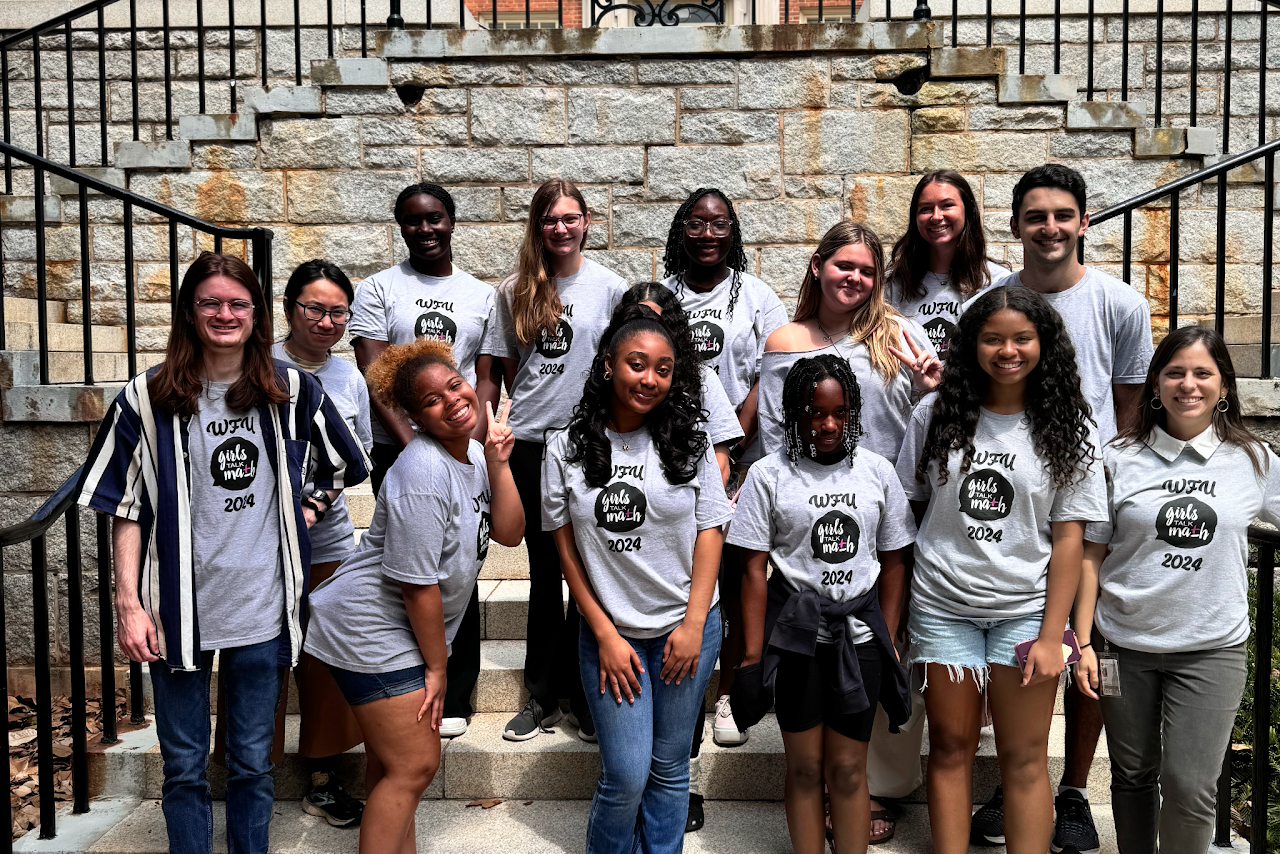
 Girls Talk Math offers a unique blend of advanced mathematics and media creation. The program is open to rising 9th through 12th grade students who are able to commute daily to Temple University's Main Campus located north of Center City. While students of any gender are welcome to apply, the program is designed with girls in mind and strives to create a welcoming environment for all. Camp lasts two weeks from 9am to 4pm, Monday through Friday. In 2025 camp will be held at Temple July 21-August 1.
During camp students work in groups on a challenging STEM problem set and research the life and work of a scientist from a marginalized group. Each student group writes and records a podcast about the scientist they research and gives a presentation about the STEM topic they studied. More than 60 camper-created podcasts are available at girlstalkmath.com and on iTunes and SoundCloud.
Girls Talk Math camps have served more than 500 students and are currently hosted at the University of North Carolina at Chapel Hill (since 2016), the University of Maryland at College Park (since 2018), Worcester Polytechnic Institute (Since 2022), and Wake Forest University (since 2024). Temple University will host a chapter of the camp for the first time in 2025.
Audience: Students entering grades 9-12
Dates: July 21 - August 1
Times: 9am-4pm, Monday to Friday
Cost: Free - Includes lunch, snacks, school supplies, public transportation funds, and a $250 stipend to be paid to each camper at the successful completion of the program.
Applications will be reviewed on a rolling basis as space allows. Applicants can expect to hear back within three weeks of submitting their application.
Girls Talk Math is funded by the Mathematical Association of America Tensor Women & Mathematics Grant and Temple University's College of Science and Technology Innovation Initiative Fund. Priority admission will be given to Philadelphia Public School students to align with funder's mission.
This program welcomes all participants regardless of age, color, disability, gender, gender expression, gender identity, genetic information, national origin, race, religion, sex, sexual orientation, or veteran status. In particular, we encourage all individuals, regardless of gender, gender expression, gender identity, and sex, to participate in this program.
View Position Descriptions and Stipends
APPLY HERE to help run camp by May 7
Questions? E-mail us at girlstalkmath@temple.edu
Girls Talk Math offers a unique blend of advanced mathematics and media creation. The program is open to rising 9th through 12th grade students who are able to commute daily to Temple University's Main Campus located north of Center City. While students of any gender are welcome to apply, the program is designed with girls in mind and strives to create a welcoming environment for all. Camp lasts two weeks from 9am to 4pm, Monday through Friday. In 2025 camp will be held at Temple July 21-August 1.
During camp students work in groups on a challenging STEM problem set and research the life and work of a scientist from a marginalized group. Each student group writes and records a podcast about the scientist they research and gives a presentation about the STEM topic they studied. More than 60 camper-created podcasts are available at girlstalkmath.com and on iTunes and SoundCloud.
Girls Talk Math camps have served more than 500 students and are currently hosted at the University of North Carolina at Chapel Hill (since 2016), the University of Maryland at College Park (since 2018), Worcester Polytechnic Institute (Since 2022), and Wake Forest University (since 2024). Temple University will host a chapter of the camp for the first time in 2025.
Audience: Students entering grades 9-12 in Fall 2025
Dates: July 21 - August 1
Times: 9am-4pm, Monday to Friday
Cost: Free - Includes lunch, snacks, school supplies, public transportation funds, and a $250 stipend to be paid to each camper at the successful completion of the program.
The program is no longer accepting applications
**No transcripts, minimum GPA, or letters of recommendation are required - just curiosity and enthusiasm!**
Applications will be reviewed on a rolling basis as space allows. Applicants can expect to hear back within three weeks of submitting their application.
Girls Talk Math is funded by the Mathematical Association of America Tensor Women & Mathematics Grant and Temple University's College of Science and Technology Innovation Initiative Fund. Priority admission will be given to Philadelphia Public School students to align with funder's mission.
This program welcomes all participants regardless of age, color, disability, gender, gender expression, gender identity, genetic information, national origin, race, religion, sex, sexual orientation, or veteran status. In particular, we encourage all individuals, regardless of gender, gender expression, gender identity, and sex, to participate in this program.
View Position Descriptions and Stipends
Staff applications are now closed.
Questions? E-mail us at girlstalkmath@temple.edu
Dianbin Bao, Temple University
We will go over the results in Section 1.5 and 1.6 in "Cohomology of Number Fields". We will focus on properties of the cohomology groups $H^n(G,A)$ if we change the group $G$, in particular the properties of restriction and corestriction maps and the $p$-primary part of $\widehat{H}^n(G, A)$.
Abstract: This talk will expand on the topics introduced in undergraduate Group Theory (Moden Algebra) courses. We will delve deeper into groups acting on sets and partitions of sets. Then we will introduce Representations and Character of Representation. Lastly, we will connect Group Theory and Graph Theory via Cayley Graphs.
And, of course, there will be free pizza!
Dylan J. Altschuler, Carnegie Mellon University
Given a collection of points in a normed space, the corresponding ``geometric graph" is obtained by connecting any pair of points with distance less than one. Say that a graph $G$ is "geometrically embeddable" into a normed space $X$ if there exist points in $X$ whose geometric graph is isomorphic to $G$. Geometric embeddability arises naturally at the intersection of combinatorics, metric geometry, and data science.
While criteria for geometric embeddings are well-studied in Euclidean space, essentially nothing is known outside this setting. We address this gap. Our result is that asymptotically almost every regular graph $G$ on $N$ vertices has the following ``universal" non-embedding property: there is no normed space of dimension less than $c \log N$ admitting a geometric embedding of $G$. This is sharp. The proof is based on an efficient multiscale ``seeded" epsilon--net argument.
(joint with Konstantin Tikhomirov; arxiv.org/abs/2501.09142)
Eriko Hironaka, Florida State University
PATCH Seminar (joint with Bryn Mawr, Haverford, Penn, and Swarthmore)
In the morning background talk (11:30am in Park 337), I will give some background on the moduli and deformation spaces of quadratic rational maps with fixed portraits and their compactifications. This talk will include definitions and techniques from the theory of rational maps, algebraic geometry, and low-dimensional topology that will be relevant to the second talk.
In the afternoon research talk (4:00pm in Park 300), I will discuss a question of J. Milnor on the moduli spaces of quadratic rational and its extension by A. Epstein. Using some of the techniques introduced in part #1, we will show that Epstein's deformation space is disconnected and give further properties. Part of this work described is joint with S. Koch.